


3 mins to read
May’s new AWS permissions span compute networking, genomics pipelines, container orchestration, and external AI platforms. The service categories are varied, but the risk pattern is consistent.
The central theme for May is “Infrastructure Hijacking.” These permissions share a common attack path: each one either extends the reach of attacker-controlled infrastructure, replaces legitimate workloads with arbitrary ones, or permanently destroys the resources security teams depend on. The ECS daemon permissions are particularly notable. Four permissions working in sequence — register, create, update, delete — cover the full lifecycle of cluster-wide workload control. Any identity holding this combination can deploy, redirect, and then erase evidence of malicious execution across an entire container fleet. The only effective control is ensuring those permissions never coexist in the same identity.
Existing Services with New Privileged Permissions
Amazon EC2
Service Type: Compute Services
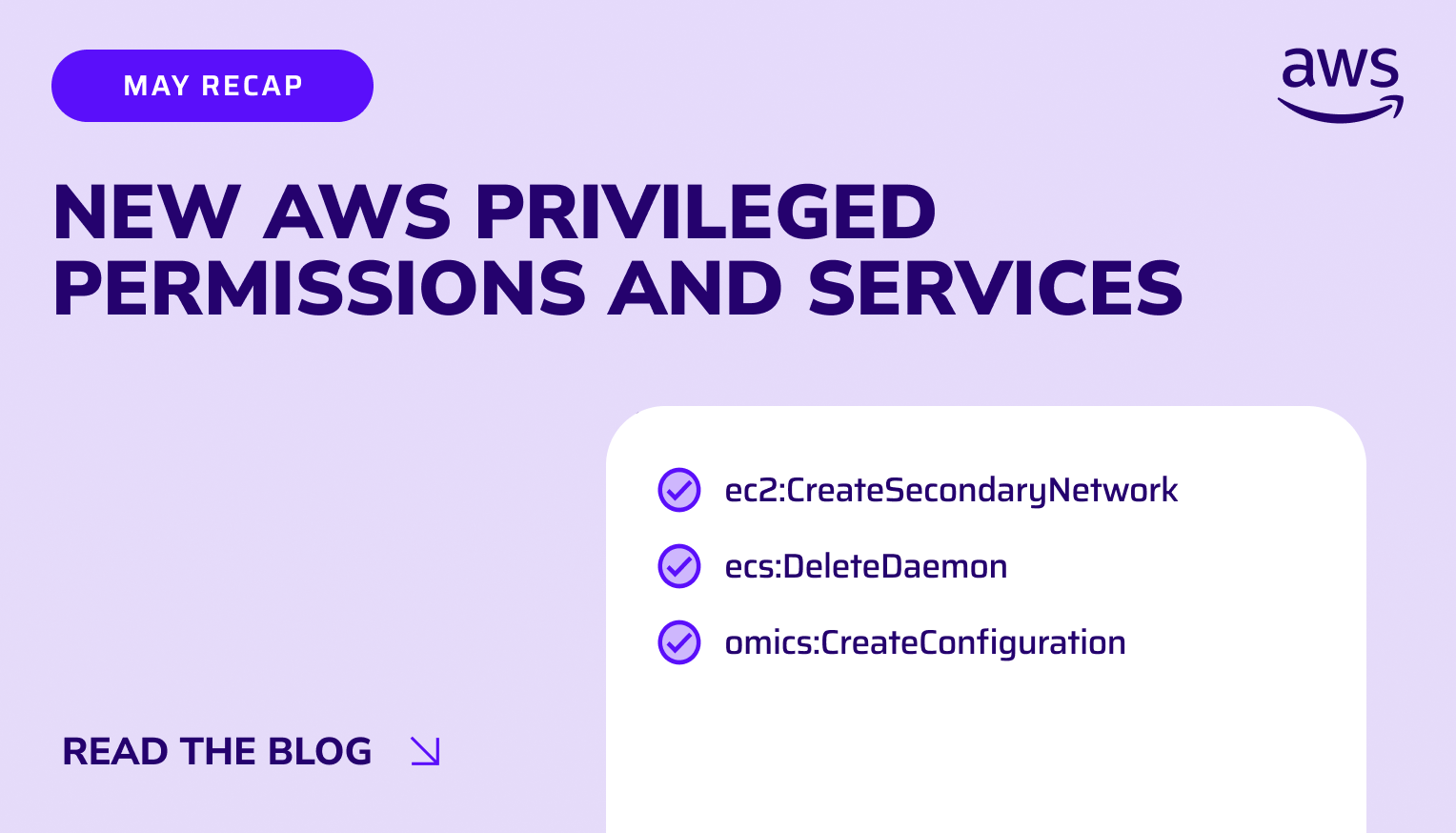
Permission: ec2:CreateSecondaryNetwork
- Action: Grants permission to create a secondary network
- Mitre Tactic: Resource Development
- Why it’s privileged: Creates an additional network interface or subnet attachment within an EC2 environment. A secondary network can route traffic outside established monitoring boundaries, establish lateral movement paths to otherwise isolated segments, or support infrastructure staging that bypasses existing network controls.
AWS HealthOmics
Service Type: Data and Analytics
Permission: omics:CreateConfiguration
- Action: Grants permission to create a new configuration
- Mitre Tactic: Defense Evasion
- Why it’s privileged: Configurations are referenced by name in Omics runs. Creating a new configuration under an existing name, with a different VPC definition, redirects any automated runs referencing that name into an attacker-controlled network without modifying the run itself or triggering any alerts on the run configuration.
Amazon Elastic Container Service
Service Type: Containers and Orchestration
Permission: ecs:CreateDaemon
- Action: Grants permission to create a new daemon in a specified cluster
- Mitre Tactic: Execution
- Why it’s privileged: Associates a task definition with a capacity provider, deploying the daemon across every container instance managed by that provider. Combined with ecs:RegisterDaemonTaskDefinition, this grants the ability to run arbitrary containers on arbitrary ECS instances across the cluster, creating a direct path for workload injection such as cryptomining or other malicious executables at scale.
Permission: ecs:RegisterDaemonTaskDefinition
- Action: Grants permission to register a new daemon task definition from the supplied family and container definitions
- Mitre Tactic: Execution
- Why it’s privileged: Defines the container image, commands, and task execution role for a daemon. Combined with ecs:CreateDaemon, this runs arbitrary code across every instance in a cluster, with access to any permissions held by the attached role.
Permission: ecs:UpdateDaemon
- Action: Grants permission to modify the parameters of a daemon
- Mitre Tactic: Execution
- Why it’s privileged: Redirects a running daemon to a different task definition across every container instance in the cluster. Combined with ecs:RegisterDaemonTaskDefinition, this replaces legitimate workloads with arbitrary containers at scale without redeploying the daemon.
Permission: ecs:DeleteDaemon
- Action: Grants permission to delete a specified daemon within a cluster
- Mitre Tactic: Defense Evasion
- Why it’s privileged: Removes security, observability, or networking agents deployed across ECS managed instances, disabling monitoring and detection before further attack activity.
New Services with Privileged Permissions
Claude Platform on AWS
Service Type: Artificial Intelligence & Machine Learning
Permission: aws-external-anthropic:ArchiveWorkspace
- Action: Grants permission to archive a workspace
- Mitre Tactic: Impact
- Why it’s privileged: Permanently destroys all workspace-scoped resources, including agents, credential vaults, skills, and sessions. Despite the “archive” label, the action is irreversible, making it functionally equivalent to deletion at the workspace level.
Conclusion
May’s additions follow a pattern that extends beyond any single service. Privileged permissions are appearing in container orchestration layers, genomics pipeline configurations, and now external AI platforms, each carrying the ability to redirect infrastructure, inject workloads, or permanently destroy operational resources.
Sonrai Security’s Cloud Permissions Firewall tracks these permissions as they are released, maps them to the MITRE ATT&CK framework, and controls them before they become a breach. When four permissions in sequence give an attacker full control of a container fleet, least privilege is not a configuration task. It is the primary control standing between your cluster and an attacker with a cryptominer.
Karen Levy