
AI agents are no longer experimental. They’re running production workloads, calling APIs, querying databases, provisioning infrastructure, and making decisions across cloud environments. Ironically these agents often end up with more access than the developers who built them. They operate with real credentials, real permissions, and real consequences when something goes wrong.
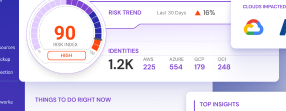
What most enterprise security teams haven’t caught up to yet is that this is fundamentally an identity problem. AI agents function as non-human identities inside cloud IAM models. They carry IAM roles, service accounts, and API keys just like any other machine identity and they inherit every weakness in how those identities are currently managed: excess permissions (92% of cloud identities are overprivileged), no ownership, and governance processes that were never built to scale.
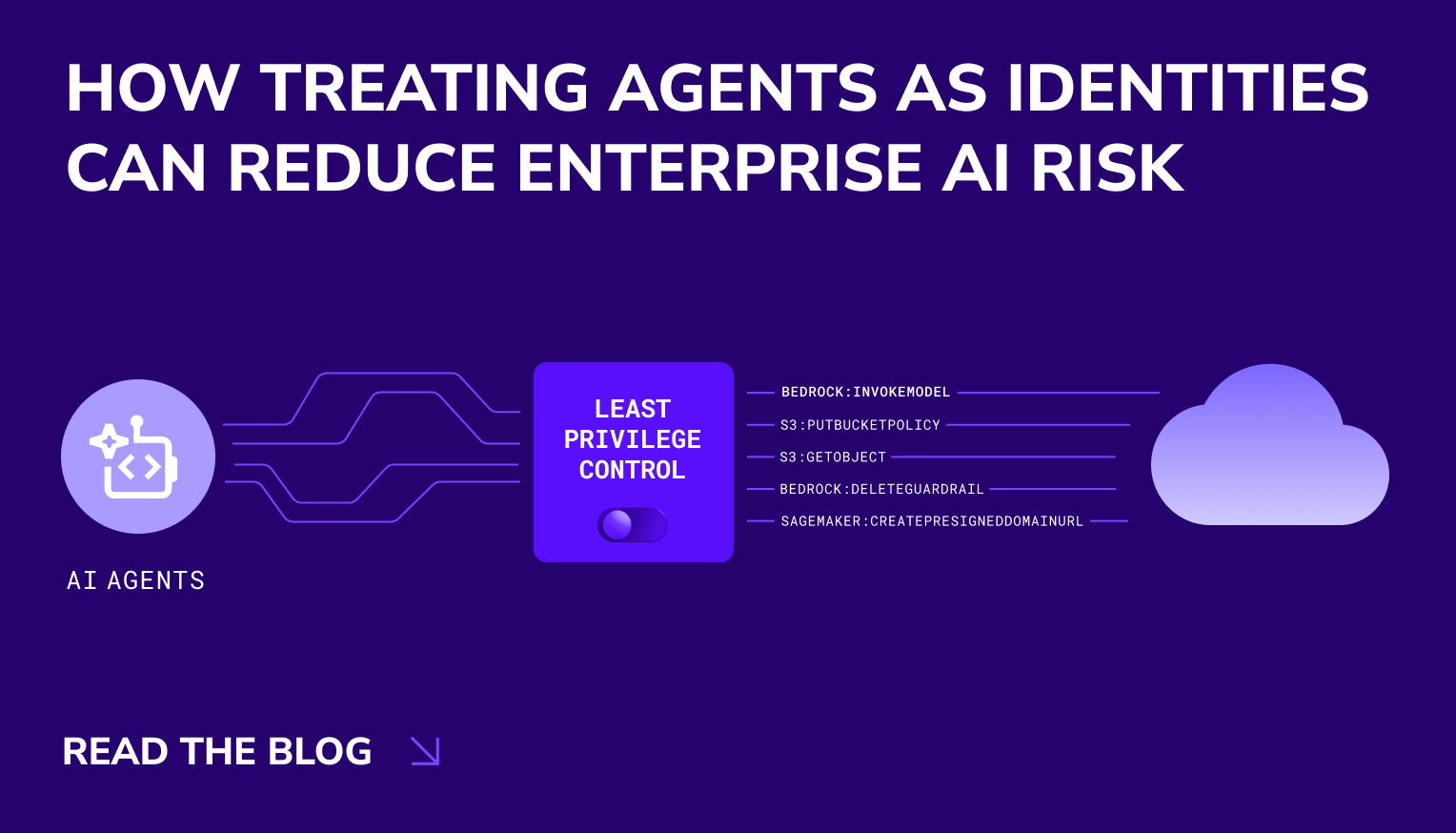
Managing AI agent identity security just like the other non-human identities – via least privilege, just-in-time access, continuous enforcement – is how we reduce enterprise AI risk.
AI Agents Are Non-Human Identities in Cloud IAM
When an AI agent is deployed, it doesn’t get a badge or a login. It gets a service account, an IAM role, or an API key. It authenticates, assumes permissions, and executes actions the same way any other machine identity does.
This means AI agent IAM controls aren’t a new security category that requires a new framework. They’re an extension of the identity problem cloud teams already live with: too many identities, too many permissions, and not enough visibility or control across any of it.
The governance model already exists. The challenge is applying it consistently and at cloud scale to a class of identities that are being deployed faster than any review process can keep up with.
Why AI Agents Make Cloud Permission Sprawl Worse
Cloud environments were already struggling with permissions sprawl before AI agents arrived. Identities accumulate access they don’t use. Teams don’t have the bandwidth to review and remediate at scale. Manual cleanup carries enough production risk that it keeps getting saved for a later date.
AI agents accelerate every part of this problem. They’re deployed quickly, provisioned broadly, and almost never reviewed after go-live.
Overprovisioned Permissions at Deployment
The most common reason AI agents are overprovisioned is an effort to avoid operational friction. Teams grant broad access upfront to prevent failures in production or ‘just in case’. It’s faster than right-sizing permissions from day one, and it works.
The problem is what comes next. Those permissions remain active indefinitely. The workload evolves. The permissions don’t. Every unused permission becomes a permanent standing privilege: always available, always exploitable if the credential is ever compromised.
Lack of Ownership and Governance
Most AI agents are deployed by engineering or operations teams, not security. There’s no formal onboarding, no access review scheduled, no entry in the identity inventory. No defined owner means no accountability and when something goes wrong, incident response stalls.
Manual IAM Management Does Not Scale
A cloud ops team of five or ten engineers reviewing permissions across hundreds of accounts and thousands of identities isn’t sustainable.
The fear of breaking production is rational. One wrong IAM policy change on a running workload can cause an outage, which is exactly why cleanup keeps getting pushed back even when teams know it’s overdue. AI agents keep getting added to this environment, compounding the problem with every deployment.
What Changes When AI Agents Are Managed as Identities
Unused Permissions Can Be Removed or Restricted
Effective AI agent access control starts with understanding what permissions are actually being used. By analyzing real permission usage and enforcing least privilege at the org level – not identity by identity – teams can systematically remove what isn’t needed without manual review cycles.
The distinction that matters here is between tools that surface the problem and tools that fix it. Reporting that an identity has 400 unused permissions is useful information, but a tool that automatically restricts those permissions using native cloud controls is active protection.
Privileged Access Shifts to Just-in-Time
Privileged permissions shouldn’t be standing access. Under a JIT model, elevated permissions are blocked by default. When an AI agent or a developer needs them, the request is made through an existing workflow like Slack, Teams or a ticketing system, approved, deployed in seconds, and automatically revoked when the task ends.
For AI agent identity management specifically, this collapses the exploitation window from indefinite standing access to the duration of a single authorized operation. If a credential is compromised between tasks, there’s nothing to exploit.
Scoped Access Reduces Blast Radius
Another benefit of least privilege for AI agents is if an agent’s credential is exposed or misused, the attacker is limited to that scoped permission set. The rest of the environment stays contained.
This is what agentic AI identity security looks like in practice: not blocking AI agents from operating, but ensuring that when something goes wrong, the damage is reduced.
Inactive Agents Are Disabled or Quarantined
Retired workflows and test agents that were never cleaned up don’t disappear, they accumulate. These zombie agent identities hold valid credentials, show up in no one’s inventory, and have no owner who would notice if they were misused. Identifying and disabling inactive agents is a basic hygiene step that reduces significant risk without breaking anything.
Where AI Agent IAM Risk Is Highest
Cloud-Native Environments
Rapid AI agent deployment without corresponding IAM governance creates permission sprawl across multi-account environments at a pace that manual processes can’t match. If high volumes of roles and service accounts with excessive permissions are the baseline then AI agents make the problem even greater.
Regulated Industries
In financial services, healthcare, and other regulated sectors, the consequences of unauthorized access aren’t just operational – they’re legal. AI agent IAM controls matter here because non-human identity actions need to be auditable, attributable, and compliant with access control requirements. Secure access and traceability are not optional.
M&A and Multi-Account Environments
Fragmented IAM across acquired entities and multi-account environments means unknown or unmanaged non-human identities are effectively invisible to the acquiring organization’s security team. Without centralized visibility, those identities can’t be governed and AI agents added post-acquisition compound an already opaque permissions landscape.
How to Reduce AI Agent Identity Risk
A structured approach to AI agent identity security doesn’t require rebuilding existing IAM infrastructure. It requires applying existing controls more consistently.
- Inventory all non-human identities. Establish a complete inventory across all cloud accounts including AI agents, service accounts, and IAM roles. You can’t govern what you can’t see.
- Review actual permission usage. Compare granted versus used permissions at the org level. Identify unused and excessive access. Prioritize high-risk identities, particularly those with privileged access or access to sensitive data.
- Prevent new standing privileges. Enforce least privilege at identity creation. Apply default guardrails that limit broad access before it becomes a cleanup problem. Remove unused permissions from existing identities.
- Implement JIT access controls. Replace standing privilege with time-bound access for privileged operations. Use approval-based workflows for sensitive actions and automate revocation when the task ends.
- Automate enforcement at scale. Apply policy-based controls across all cloud accounts. Eliminate reliance on manual IAM reviews that won’t get done. Ensure least privilege is enforced continuously, not periodically.
Why Legacy PAM Does Not Work for AI Agents
Traditional Privileged Access Management tools were designed for human users accessing systems through sessions. They weren’t built for machine identities operating at cloud scale, and they show it.
Legacy PAM can’t inventory or govern the volume of non-human identities in a modern cloud environment. It doesn’t enforce least privilege continuously, instead controls access by vaulting credentials. And it provides no mechanism for the kind of org-level permission enforcement that AI agent access control requires.
The mismatch isn’t a configuration problem. It’s architectural. Agentic AI identity security requires tooling built for machine identities in cloud IAM, not adapted from tools built for humans in data centers.
Conclusion
AI agents are an identity problem. Luckily, the solutions already exist. The challenge is applying it to a class of non-human identities that are being deployed faster than current processes can handle.
The risk is specific: excess permissions granted at deployment and never reduced, no defined ownership or accountability, and manual governance processes that can’t scale to cloud environments. These aren’t abstract threats. They’re the conditions that turn a compromised credential into a breach.
The path forward is concrete: treat AI agents as identities, enforce least privilege at the org level, shift privileged access to JIT, automate enforcement, and disable agents no longer in use. The organizations that apply IAM controls to AI agents with the same rigor they apply to human identities won’t regret it.
How Sonrai Addresses AI Agent Identity Risk
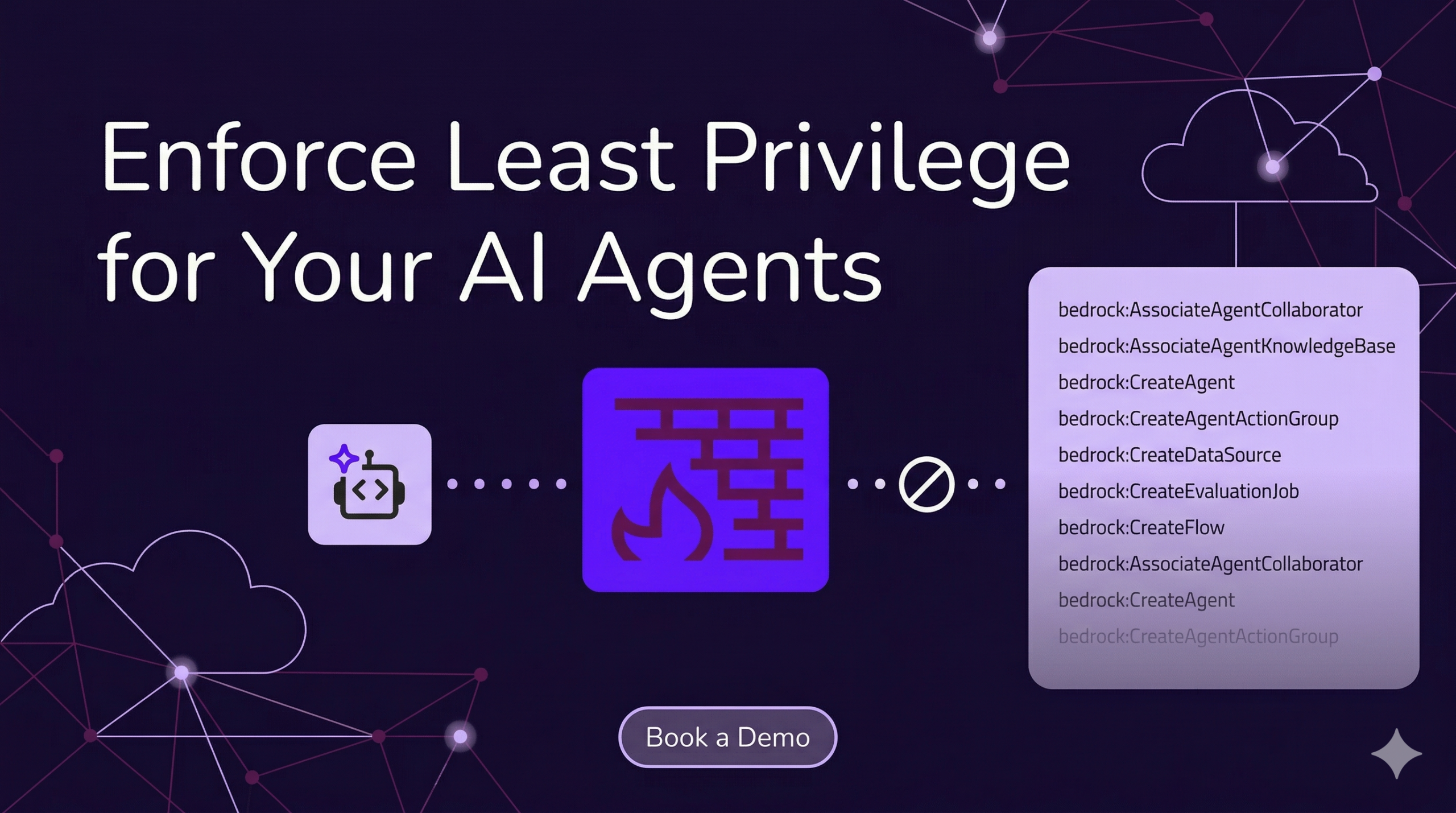
Sonrai’s Cloud Permissions Firewall (CPF) is built on one principle: if an agent can’t do unauthorized things, the sophistication of the attack doesn’t matter.
- AI Agent Identification & Inventory: Automatically discover every agent identity and the human users who granted them permissions
- Automated Least Privilege Enforcement: One-click blocking of unused permissions via cloud-native controls, applied automatically across every agent
- Default-Deny for Privileged Actions: Sensitive AI actions (e.g., bedrock:UpdateFlow) are blocked unless explicitly approved — agents can’t escalate themselves
- Agent Quarantining: Instantly deactivate unused or compromised agents without deleting them — remove the attack path, preserve the config
- Permissions on Demand (PoD): Authorized owners approve temporary, time-limited access via Slack or Teams — DevOps keeps moving, default-deny stays intact
Frequently Asked Questions
What is the difference between an AI agent and a standard non-human identity?
A standard non-human identity — a service account, a CI/CD pipeline role, an automation script — performs a defined and usually static set of actions. An AI agent is dynamic: it reasons, makes decisions, and can take a range of actions depending on context. That dynamic behavior makes governance more complex, because the permissions an agent might need aren’t always predictable at deployment. The answer isn’t to grant more access. Instead, it’s to enforce least privilege and JIT access so the agent operates within a controlled boundary regardless of what it decides to do.
Does a Cloud Permissions Firewall require agents or proxies installed in my cloud?
No. Native cloud controls are applied directly through the cloud provider’s policy layer, with nothing installed in the data path. This means there’s no additional infrastructure to manage, no latency introduced, and no new failure mode to engineer around.
What is JIT access and how does it apply to AI agents?
Just-in-time access means elevated permissions are not standing. Instead, they don’t exist until they’re requested, approved, and granted for a specific task. For AI agents, this means privileged permissions are off by default. When an agent needs elevated access to complete an operation, the request goes through an approval workflow, access is granted for the duration of the task, and it’s automatically revoked when done. The exploitation window for a compromised credential shrinks from indefinite to near-zero.
How quickly can least privilege be enforced across a large cloud environment?
With policy-based enforcement using native cloud controls, restrictions can be applied at the org level without touching individual identities one at a time. The timeline depends on the size and complexity of the environment, but it can be days, not months or quarters.
How do we handle AI agents deployed by teams outside of security?
This is one of the most common governance gaps. The practical answer is to establish guardrails at the infrastructure level — default permission boundaries, mandatory inventory onboarding, and automated alerts for newly deployed identities without defined owners — so that governance doesn’t depend on every team following a process. Engineering teams shouldn’t need to become IAM experts. Security teams shouldn’t need to manually review every deployment. The controls need to work even when the process doesn’t.